
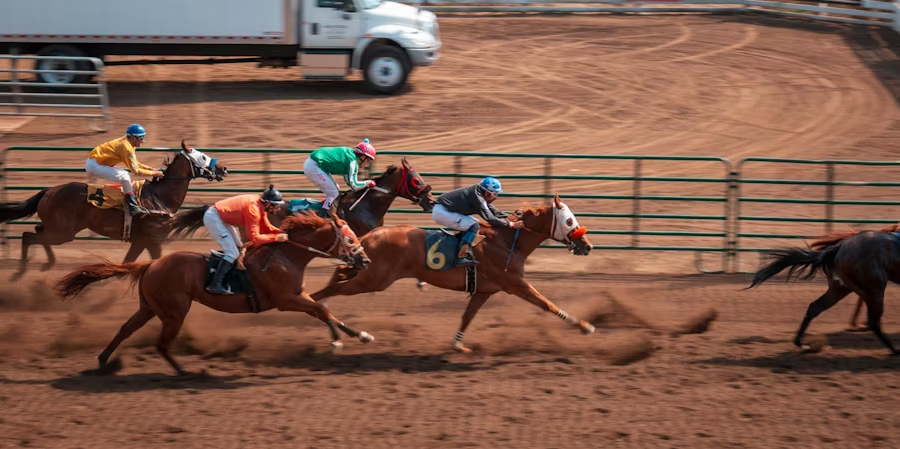
Pari-mutuel vs fixed-odds horse racing betting is the choice between wagering into a shared pool where final payouts are determined after betting closes, and locking in a guaranteed price at the moment you place your bet. In 2026, approximately 62% of U.S. horse racing handle still flows through pari-mutuel pools, but fixed-odds wagering has grown by over 40% year-over-year since its legalization expansion began in 2022. Understanding when each format gives you a mathematical edge is now one of the most important skills a serious bettor can develop.
What Is the Difference Between Pari-Mutuel and Fixed-Odds Betting?
The core difference comes down to when your payout is determined.
In pari-mutuel betting, all wagers on a race go into a shared pool. The track or ADW takes its cut — typically called the takeout, which ranges from 14% to 30% depending on the bet type and jurisdiction — and then distributes the remaining money proportionally among winning ticket holders. You do not know your exact payout until the pool closes at post time. If heavy late money comes in on your horse, your odds drop. If a sharp bettor hammers a different runner in the final flash, your price might improve.
In fixed-odds betting, you lock in a specific price the moment you click "confirm." If you take 8/1 on a horse and it wins, you get paid 8/1 regardless of what happens to the market afterward. The bookmaker absorbs the risk, and the price is set based on their proprietary models and risk management.
Here is a simplified comparison:
- Pari-mutuel: Final odds unknown until post · takeout is public · pool liquidity matters · exotic bet availability is excellent
- Fixed odds: Price locked at bet time · bookmaker margin is embedded in the price · available primarily on win/place markets · growing U.S. availability in 2026
Both formats have structural advantages. The key is knowing which one rewards your specific style of handicapping.
When Does Pari-Mutuel Betting Give You a Bigger Edge?
Pari-mutuel betting rewards you most when you are betting against the public and when the pool is large enough to absorb your wager without significantly moving the odds.
Here are the scenarios where pari-mutuel pools tend to offer superior value:
- Exotic bets (exactas, trifectas, Pick 4s, Pick 6s): Fixed-odds operators rarely offer exotic wagering at competitive prices. If your edge is in structuring multi-leg and multi-horse wagers, pari-mutuel pools remain your primary — and often only — option. The structural inefficiency of exotic pools, where casual bettors create dead money by boxing favorites, makes them among the most profitable bet types for skilled handicappers.
- Large-field races with public bias: When a heavy favorite is over-bet by the public in a 12-horse field, every other runner in the pool offers an inflated price. The 2026 spring stakes season has already produced multiple examples of this — races at Keeneland's April meet where post-time favorites of 4/5 lost, and the pari-mutuel win pool paid $18+ on a logical second choice.
- Carryover pools and mandatory payouts: These pools, unique to pari-mutuel wagering, create positive expected value situations that fixed-odds simply cannot replicate.
- Late information plays: If you watch the paddock and see a horse warming up poorly, other horses in the pool become better value as money continues to flow on the weakened favorite. In pari-mutuel, you benefit from every dollar of "dead money" bet on horses that have diminished chances.
The takeout is the obvious disadvantage. A 20% blended takeout on an exotic pool means you need to be significantly more accurate than the crowd just to break even. But skilled handicappers who target inefficient pools — especially low-profile races at mid-tier tracks — can find takeout-adjusted edges that exceed anything available in fixed-odds markets.
When Does Fixed-Odds Betting Pay More Than the Tote?
Fixed-odds betting shines when you are early and right. If your handicapping identifies a winner before the market fully adjusts, locking in a price protects your edge from being eroded by late money.
Fixed odds are better in these situations:
- Early value on likely winners: If you identify a probable winner at 6/1 in the morning and the horse closes at 5/2 on the tote, you captured 140% more value by locking in the fixed price. This is closing line value in its purest form, and it is the single best predictor of long-term betting profitability.
- Short-priced horses where takeout destroys value: On a horse that will be 3/5 in the pari-mutuel pool with a 17% WPS takeout, the effective return is further compressed. A fixed-odds operator might offer 4/5 or even 1/1 on the same horse early in the day because their models have not yet fully adjusted. That difference — even a few percentage points — compounds dramatically over hundreds of bets.
- Thin pools at smaller tracks: Pari-mutuel pools at low-handle tracks can be dangerously thin. A $200 win bet might move a horse from 8/1 to 5/1, destroying your own value. Fixed-odds platforms let you bet your full amount at the quoted price without impacting the line — at least until the operator adjusts.
- Price certainty for bankroll management: When you use a staking method like Kelly, you need to know the exact odds you are getting to calculate optimal bet size. Fixed odds give you that certainty; pari-mutuel does not.
The growth of fixed-odds horse racing in the U.S. has been accelerating through 2026. FanDuel Racing, BetMGM, and several state-specific platforms now offer fixed-odds win and place markets on most North American thoroughbred and harness races. New Jersey, which fully legalized fixed-odds horse racing wagering in 2024, has reported that fixed-odds now represents roughly 28% of total digital horse racing handle within the state as of Q1 2026.
How Can You Use Both Formats Together for Maximum Profit?
The most sophisticated bettors in 2026 are not choosing one or the other — they are arbitraging between formats and selecting whichever offers the better price on a race-by-race, bet-by-bet basis.
Here is a practical workflow:
- Complete your handicapping first. Assign your own probability estimates to each horse before looking at any odds. Tools like [StrideOdds](https://www.strideodds.ai) use AI to generate probability models that help you establish a fair-value line before the market opens.
- Check fixed-odds prices early. As soon as fixed-odds markets open — often the morning of the race — compare the available price to your fair-value estimate. If the fixed-odds price exceeds your threshold, lock it in.
- Monitor the pari-mutuel pool throughout the day. Sometimes the tote offers a better price than fixed odds, especially when a horse drifts on the board due to public bias toward a different runner.
- Reserve exotic wagers for pari-mutuel. There is currently no viable fixed-odds alternative for trifectas, superfectas, or multi-race wagers. Your exotic action stays in the pools.
- Track your results by format. Keep a separate ROI log for pari-mutuel and fixed-odds bets. Over a sample of 200+ bets, you will see which format your handicapping style exploits more effectively.
This dual-format approach effectively lets you shop for the best line, a concept borrowed from sports betting that is now fully applicable to horse racing. The bettor who compares pari-mutuel morning lines, live tote odds, and fixed-odds prices across multiple platforms before betting has a structural advantage over someone who only uses one channel.
What Are the Risks and Limitations of Each Format?
Neither format is without drawbacks. Being honest about the limitations helps you avoid costly mistakes.
Pari-mutuel risks:
- Takeout is high and non-negotiable (unless you use a rebate shop). A 22% takeout on trifectas means the pool must be structurally inefficient for you to profit.
- Late pool movement can destroy value. You might see 10/1 on your horse with two minutes to post, only to see it collapse to 5/1 after a large syndicate bet.
- Pool manipulation exists at smaller tracks. Sophisticated actors can move thin pools to create artificial value or trap unsuspecting bettors.
Fixed-odds risks:
- Bookmaker limits and account restrictions. If you are a winning bettor, fixed-odds operators may reduce your maximum stake or close your account — a well-documented problem in sports betting now migrating into horse racing.
- Narrower market selection. Most U.S. fixed-odds platforms in 2026 only offer win and place markets. No exotics, no show betting, and limited international coverage.
- Early prices can be traps. Bookmakers intentionally offer attractive early prices on horses they believe the public will bet later, knowing the late money on favorites will balance their book. If you are consistently taking early prices on horses that shorten, you are likely winning. If you are taking early prices on horses that drift, your selection process may need work.
How Do You Decide Which Format to Use for the 2026 Spring Stakes Season?
With the Kentucky Derby just two weeks away and Keeneland, Oaklawn, and Aqueduct all running full spring cards, the question is immediately practical.
For the Derby itself, the pari-mutuel pools will be enormous — the 2025 Kentucky Derby generated over $285 million in total handle. Pools that large are highly efficient on win/place bets, making it difficult to find tote value on contenders. This is where fixed odds may offer early-week prices that exceed what the tote will pay on Derby day. Lock in your top pick early if the fixed price offers closing line value.
For undercard stakes and smaller track races running throughout April and May, the pari-mutuel pools are often small enough to contain significant inefficiencies. This is where exotic pool specialists thrive.
A smart framework for the spring:
- Win bets on major stakes: Compare fixed odds vs. tote and take the best price. [StrideOdds](https://www.strideodds.ai) provides AI-driven fair-value odds that make this comparison faster and more accurate.
- Exotic bets on any race with 8+ runners: Use pari-mutuel pools and structure tickets using your own fair-value probabilities.
- Place and show bets: Check fixed-odds platforms first — the pari-mutuel place/show pools often have higher effective takeout than the win pool, and fixed prices can be surprisingly generous.
The bottom line: the format you choose is not a philosophical commitment — it is a tactical decision that should change from race to race. The bettor who treats both pari-mutuel and fixed odds as tools in a toolkit, selecting the sharper instrument for each situation, will outperform the bettor who only knows one way to wager.
Written by StrideOdds.